
What to Look for in Global Survey Data Services
Learn what to check in global survey data collection services, from panel quality and market reach to fieldwork support and compliance.
Quick answer
A provider can cover dozens of countries and still be the wrong fit for your study.
When evaluating global survey data collection services, look beyond price and geographic reach. The strongest partners should be able to explain:
- How respondents are verified
- Where their sample comes from
- How surveys are localized
- How active fieldwork is monitored
- Whether operations can scale across markets
- How privacy and research standards are handled
- How much local market expertise supports the fieldwork
For multi-market research, these details often determine whether a project runs smoothly—or spends the fieldwork period solving avoidable problems.
1. Do you know who is actually answering your survey?
Good data starts with real, qualified respondents.
Before choosing a provider, ask what happens before and after someone enters a survey. Registration checks alone are not enough; quality monitoring should continue throughout fieldwork.
Look for controls such as:
- CAPTCHA or bot screening
- Duplicate detection
- Profile validation
- Speeding and straight-lining checks
- Open-end review
- Behavioral monitoring
- Project-level rejection rules
The ESOMAR/GRBN Guideline on Online Sample Quality recommends evaluating participant validation, fraud prevention, engagement, screening, exclusions, and sample transparency.
AAPOR’s guidance on online sample quality also reinforces an important point: data quality should be considered during study design and fieldwork, not only during final cleaning.
What to ask:
“How do you detect low-quality respondents while my survey is live?”
2. Does “global coverage” actually include the respondents you need?

A large global panel number can sound impressive. But it tells you very little about whether a provider can reach your audience in each individual market.
A strong provider should be transparent about:
- Countries covered directly
- Panel depth by market
- Recruitment sources
- Proprietary, partner, or blended sample
- Audience availability
- Demographic limitations
- Expected feasibility
For example, having strong general-population coverage does not automatically mean the same provider can efficiently recruit IT decision-makers in Vietnam or older consumers in Japan.
ESOMAR’s 37 Questions to Help Buyers of Online Samples provides a useful framework for investigating sample sources, recruitment methods, profiling, and supplier transparency.
What to ask:
“Where will my respondents actually come from in each market?”
3. Is the survey being translated or truly localized?
There is a big difference.
Translation changes the language. Localization makes sure the question still means what you intended.
In multi-market studies, differences in terminology, cultural norms, demographic categories, and response scales can change how respondents interpret the same questionnaire.
Look for:
- Native-language review
- Local terminology checks
- Translation validation
- Cultural adaptation
- Market-specific demographic categories
- Mobile testing
- In-country review where appropriate
This matters because a technically correct translation can still sound unnatural or confusing to a local respondent.
The ICC/ESOMAR International Code provides a broader framework for responsible and transparent research practice across markets.
What to ask:
“Who reviews the questionnaire before it goes live in each country?”
4. What happens when fieldwork does not go according to plan?

Because at some point, it probably won’t.
One country may fill immediately while another stalls. A quota may suddenly overfill. A survey route may break, or quality flags may appear halfway through fieldwork.
This is where operational support becomes just as important as panel size.
Check:
- Who monitors live fieldwork?
- How often are quotas reviewed?
- How quickly are issues escalated?
- What happens when a market falls behind?
- Who can adjust sampling?
- How are updates communicated across time zones?
For international survey services, extended or 24-hour operations can help keep projects moving while client teams in another region are offline.
But “24/7” should mean more than someone being available. It should come with clear handovers, monitoring, and escalation processes.
What to ask:
“If something goes wrong while our team is offline, what happens next?”
5. Can the operation scale without sacrificing consistency?
A provider that performs well on a 300-person study in one country may face very different challenges with a 10-market study involving thousands of respondents.
For large-scale online surveys, look at whether the provider can scale:
- Sample recruitment
- Survey programming
- Parallel fieldwork
- Quota monitoring
- Data processing
- Quality controls
- Mobile survey execution
- Project communication
The real test of scalability is not simply whether a provider can collect more responses. It is whether the same quality and operational standards remain consistent as the study grows.
Mobile readiness is particularly important in Asia Pacific. The GSMA Mobile Economy Asia Pacific 2026 highlights the continuing importance of mobile connectivity across the region, making smartphone-friendly survey execution increasingly relevant to online research.
What to ask:
“How do your processes change when a project expands from one market to ten?”
6. Can the provider explain how your data is protected?
Multi-market research often means data moving across jurisdictions.
That makes respondent consent, privacy, secure handling, and cross-border data transfers important parts of vendor evaluation—not just legal fine print.
Check how the provider handles:
- Respondent consent
- Personal information
- Data minimization
- Confidentiality
- Secure transfers
- Data retention
- Anonymization
- Market-specific privacy requirements
The 2025 ICC/ESOMAR International Code sets global principles for responsible research conduct.
Research buyers can also reference ISO 20252:2026, the current international standard covering service requirements for market, opinion and social research, including insights and data analytics.
What to ask:
“What standards and processes govern how respondent data is collected, transferred, and stored?”
7. Does the provider understand the market or just have access to it?
Having respondents in a country is not the same as understanding how fieldwork works there.
Regional experience can help teams anticipate:
- Realistic incidence rates
- Difficult audience segments
- Local holidays
- Survey participation patterns
- Mobile behavior
- Language nuances
- Incentive preferences
- Seasonal changes
- Recruitment limitations
That knowledge becomes especially valuable when overseas fieldwork spans markets with very different research environments.
A locally informed team can flag feasibility risks before launch instead of explaining them after a deadline has already passed.
What to ask:
“What should we know about fielding this study in this particular market?”
A simple checklist before choosing a global survey data provider
Before signing off on a provider, make sure you can answer these questions:
|
Check |
Question to ask |
|
Quality |
How are respondents verified and monitored? |
|
Sample |
Where does the sample come from in each country? |
|
Localization |
Who reviews the survey for local language and context? |
|
Operations |
Who monitors fieldwork when our team is offline? |
|
Scale |
Can the same standards be maintained across all markets? |
|
Compliance |
How is respondent data protected? |
|
Local expertise |
What market-specific risks should we plan for? |
If a provider struggles to answer these questions clearly, that is useful information in itself.
How dataSpring supports multi-market survey data collection
For research teams conducting studies across Asia, dataSpring supports online data collection through regional panel access, respondent quality controls, fieldwork management, mobile research capabilities, and 24/7 operations.
Support includes:
- Asian panel access
- Panel quality processes
- Online data collection services
- Mobile research capabilities
- Regional operations support
- Survey programming support
- Local-language coordination
- Multi-country fieldwork management
- Project-level quality monitoring
dataSpring’s focus is on helping research teams reach the right respondents and execute reliable data collection across Asian markets.
Conclusion: Country coverage is only the beginning
Choosing global survey data collection services should not come down to who has the longest market list or the fastest quoted timeline.
The more useful questions are:
Who are the respondents? Where did they come from? How are they verified? Who is watching the fieldwork? And what happens when something changes?
For large-scale online surveys and overseas projects, those operational details can make the difference between simply collecting responses and collecting data your research team can confidently work with.
Ready to plan your next multi-country study?
Work with dataSpring to reach verified respondents and manage online fieldwork across Asian markets.
Contact dataSpringFAQs
What should I look for in global survey data collection services?
Are proprietary panels always better than third-party samples?
Why does regional expertise matter in global survey research?
Why is localization important for multi-country brand tracking?
How important is 24-hour fieldwork support?
How does dataSpring support international survey projects?
Related resources

dataSpring's industry-leading Quality Check System ensures data validity and valuable insights.
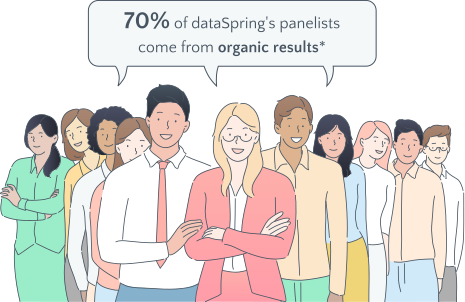
Find out the sources that dataSpring uses to build its proprietary Asian panel.

Local market research trends across the region.

 Download Panel Book



